
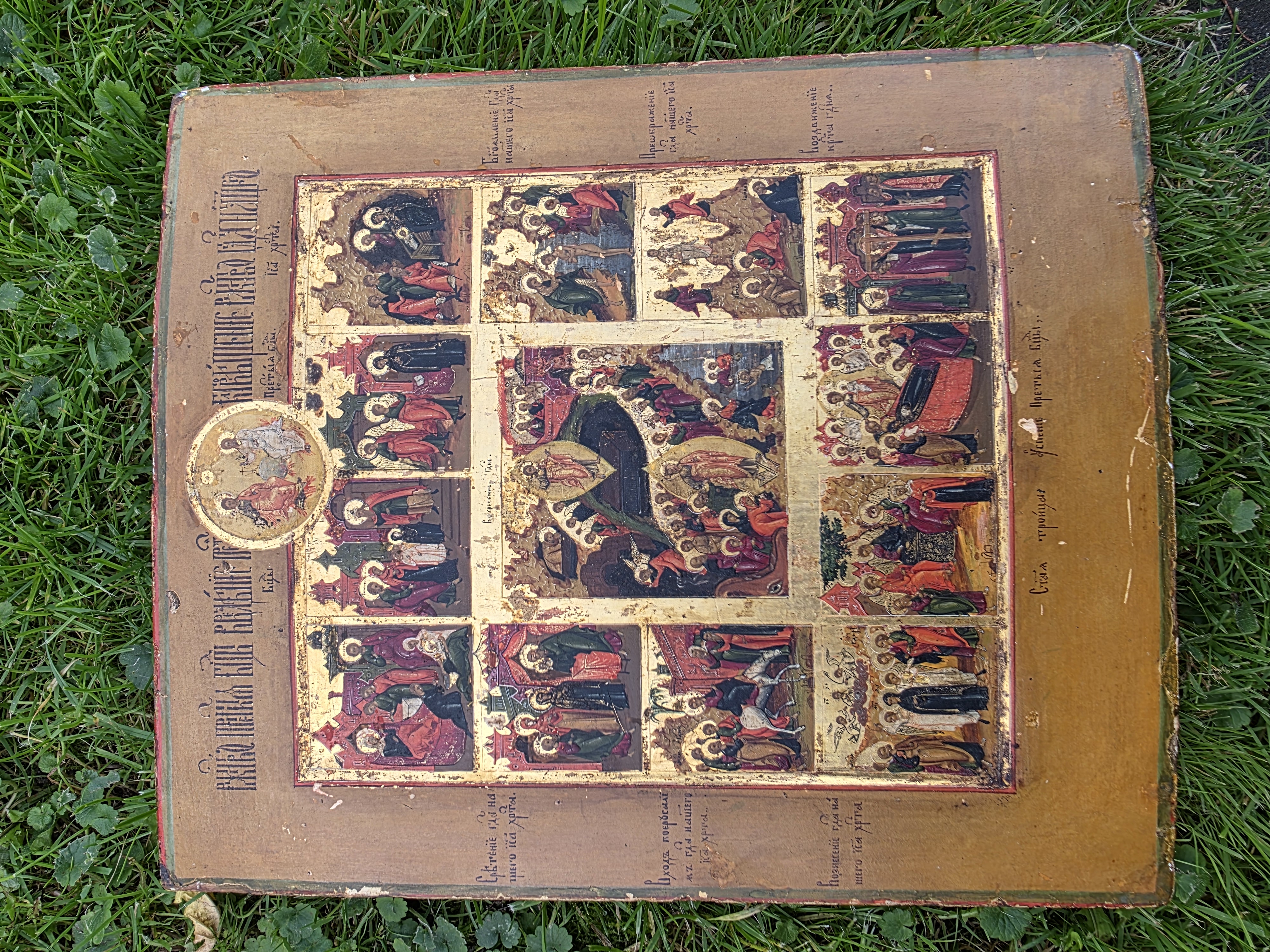
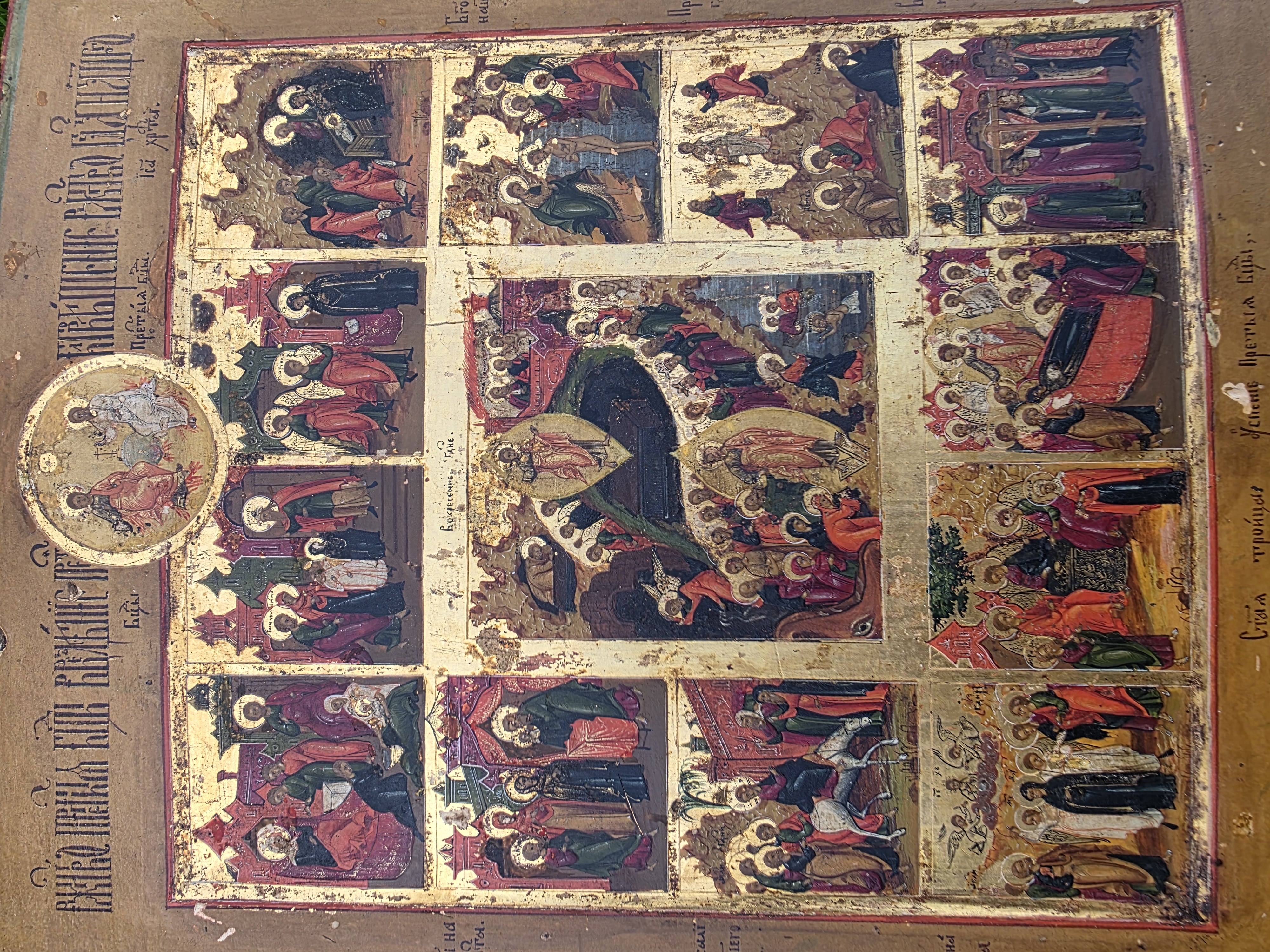
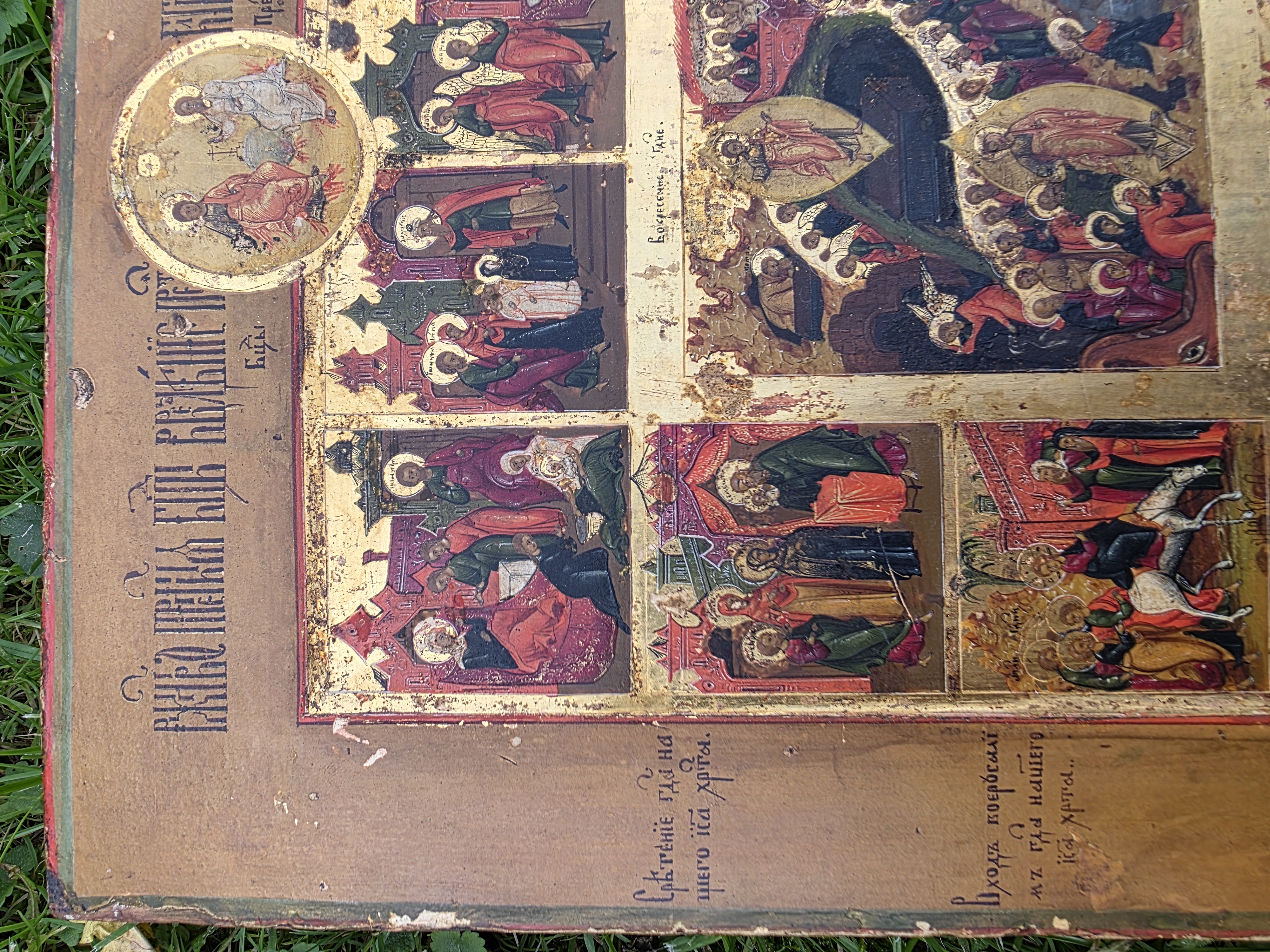
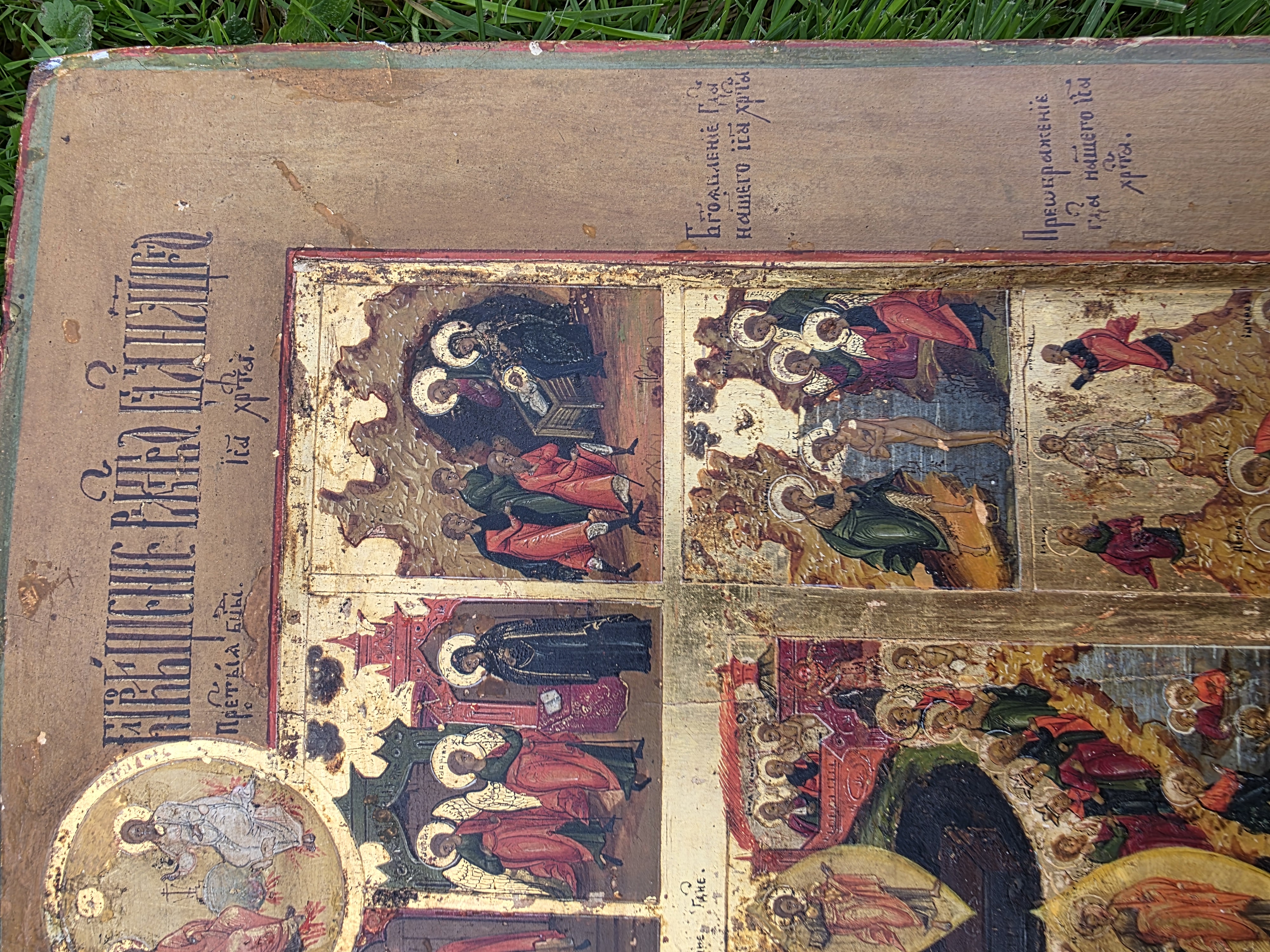
A calendar in images
Festal icons gather the major Feasts of the Church into a single field. The Nativity, Baptism, Crucifixion, Resurrection and other events appear as distinct but connected scenes. Their scale encourages close looking: a gesture, a tower, a small angel or a line of gold can carry the theological meaning of an entire feast.
The Dodekaorton and liturgical time
The festal cycle, or Dodekaorton, is one of the central systems of Orthodox iconography. It does not function as an illustrated calendar in the modern sense. Each feast is a condensed theological statement: the Nativity reveals the Incarnation, the Baptism manifests the Trinity, the Transfiguration reveals divine glory, and the Crucifixion and Resurrection articulate the passage through death to life. A multi-panel icon makes these doctrinal relationships visible through sequence and repetition. The scenes must be read through liturgical memory as much as narrative detail. Architecture, gesture and colour establish typological links between Old and New Testament events. The small scale of the panels is not a reduction of importance; it is a request for attentive, devotional looking. The present icon’s inscriptions and individual fields warrant specialist examination before a complete cycle can be identified.
Georgian feast traditions
Georgian Orthodox feast practice is visible in the monumental programmes of Gelati, Kintsvisi and Vardzia, where biblical scenes are organised around church architecture and liturgy. Gelati’s twelfth-century monastery and academy connected worship with theological learning; Vardzia’s rock-cut churches connected sacred narrative with a monastic landscape. These Georgian examples provide a precise comparison for the function of a festal icon: organising the events of Christian history for liturgical remembrance.
Russian festal icons are particularly useful for comparing the relationship of scene, border and liturgical sequence. Georgian church painting provides a second comparison because its programmes are inseparable from buildings such as Gelati, Kintsvisi and Vardzia. In both cases, the viewer does not read an isolated image in the manner of a modern illustration. Meaning is produced through adjacency, repetition and the calendar of worship. This panel can therefore be discussed through established Orthodox visual systems without assigning it a Georgian provenance.